
Personal Finance Health Predictor
Personal Project
Machine Learning Engineer · Aug 2025 – Nov 2025 · Remote
Overview
This project looks at 285,000+ financial records to answer three business questions: which borrowers are likely to be a credit risk, which transactions are fraud, and what kinds of customers a financial company serves. The goal was to turn raw data into predictions a lender or marketing team can act on.
Challenge
Fraud is rare, so it's easy to miss. Reviewing loans by hand takes time, and marketing campaigns often go to everyone instead of the right customers. The results also had to be usable by other systems, not just sit in a notebook.
Solution
I built models that score credit risk, flag likely fraud, and sort customers into groups, then made them available through an API so other tools can use the predictions. I also made 40+ charts to explain what drives the results in plain terms.
Key Features
Credit risk prediction to flag risky borrowers
Fraud detection that catches rare, costly events
Customer personas for more personalized recommendations
40+ charts that explain what drives each prediction
A ready-to-use API for loan review and marketing teams
Work Done
- 1
Three datasets, three problems
Lending Club data for credit risk, a credit card fraud dataset for fraud detection, and German Credit data as an additional credit check, together over 285,000 records.
- 2
Credit risk
Compared logistic regression, random forest, XGBoost, and LightGBM to find the model that best separates safe borrowers from risky ones.
- 3
Fraud detection
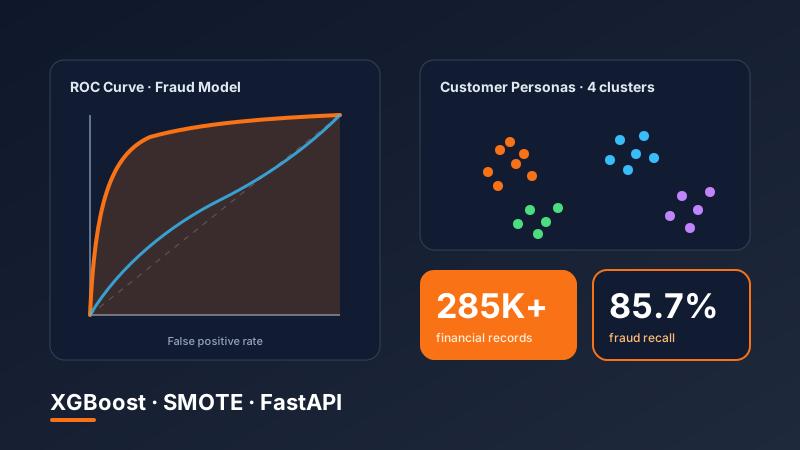
Fraud is rare, so the data is heavily imbalanced. I balanced it with SMOTE and trained XGBoost and Isolation Forest, reaching 85.7% recall.
- 4
Customer segmentation
Used PCA with K-means, hierarchical clustering, and DBSCAN to find 4 customer personas.
- 5
Features and evaluation
Engineered 26+ features and evaluated models with 40+ visualizations, including ROC curves, confusion matrices, and feature plots.
- 6
Serving predictions
Exposed the models through a FastAPI service with 3 prediction endpoints and Pydantic request validation.
Impact
Caught 85.7% of fraud cases in the fraud detection model
Reduced manual loan review effort by 30%
Improved marketing conversion by 15 to 20% by identifying 4 distinct customer personas
Analyzed more than 285,000 financial records across three datasets
Explained results with 40+ visualizations that non-technical teams can read
Delivered 3 prediction endpoints that other tools can call